Friday, November 4, 2011

Mandalay, Myanmar

We arrived at twilight and just as were trying to figure out how to get to our prefered guesthouse a man comes up to us holding a sign that says “Royal Guest House”. Perfect! We jump in. Half an hour later we are dropped off at the guesthouse to find it is full (?), and now we have to pay for the ride (we assumed it was operated by the guest house, and therefore free). We walk onwards and find another option (“E.T. Hotel”). But our room is good value, and has air-conditioning (a treat) so we crawl back into bed to catch up on the z’s we missed the night before.

A classic example of a well-organized intersection in Myanmar. No traffic lights or stop signs, just a free-for-all. Horns are used almost continually, and helmets are usually worm but rarely done up.

After a long nap and a shower the three of us (we are now travelling with Maria, an Estonian who we met in Yangon) set out to explore. First stop is a Lashio Lay Restaurant where we have a shan-style buffet. You point at the dishes you want from a couple dozen options and they bring these to your table, along with simple salad (green cabbage, iceberg lettuce, cucumber) and plenty of rice. Meat dishes were about K1000 (~1.20) and veggie dishes around K500.
We enjoy it because it is tasty and we are starving, but in hindsight it was very oily (like all the food in Myanmar) and it may have been the source of some later G.I. upsets, but we're not sure. Later on in the trip, we learned that the excessive oiliness serves a few functions; it rests in a layer on top of the food and acts as an environmental barrier (against flies), keeps the food "fresh" and also signifies prosperity (oil means wealth). It is tasteless palm oil, and we quickly started to search for any kind of food that was less oily.
After lunch we venture into the zeigyo (central market); a large multi-story indoor market.  Here we find mostly local necessities (including hundreds of shops selling cloth for longyi). Maria and I decide we need a longyi if we are going to be visiting temples so we buy a few meters of fabric for a couple dollars each and head upstairs to have them tailored (for about a dollar). A longyi consists of about 2 meters of fabric sewed together at the ends to form a tube, with a black waistband. You step into the tube (which is about ankle length), wrap the longyi around your waist and tuck the excess into the waistband. They are a bit cumbersome to walk in, but I'm sure you would grow used to it. Myanmar is by far the most traditional country I've been to in the sense that a good 90% or more of the adult population still wears the traditional longyi (as opposed to Western-style clothing) as everyday attire.
There are also some stalls selling antiques and various trinkets, including these brass figurines and monkey-skull necklaces, which supposedly protect the wearer from bad spirits.
Later that evening (after another nap, haha) we arrange with a taxi driver to take the three of us up to Yankin Paya, a hil about 3 miles east of Mandalay Palace with good view of the city. By far the most famous hill is Mandalay Hill but in order to climb to the top you likely need to purchase the “$10 Combo Ticket”. We were trying to boycott doing so because the entirety of that $10 goes to the corrupt military government, not to the people. Yanking Paya on the other hand, is far less touristy, and free. We had negotiated with the taxi driver to take us there, wait for us to climb to the top for sunset, and drive us back for about $5 a person. He didn’t tell us how long it would actually take to drive those three miles (weaving through markets and neighbourhoods, and stopping to show us a pagoda) so by the time we reached the top it was essentially dark. The last colours of the sunset were just beginning to fade so we could get an idea of the view from the top, which was fine.
 

On day two in Mandalay we set out to explore some more of the city. We made the mistake of putting a water bottle (which was nice and cool from being in our air-conditioned room) inside the day pack with Dewey’s camera. The water bottle began to sweat from the huge temperature difference and we nearly ruined Dewey’s camera. We took the battery out and dried the camera off, and luckily about 24 hours later everything seemed to operate as usual. We explored the “gold leaf district” where 70 or so shops make gold leaf. The hand-pounded gold leaf is primarily used to adorn Buddha images across the country. Maria and I bought about 10 small sheets of 24K gold (about 0.0005inches thick) for about $6 between the two of us. As a fun fact, gold leaf is also “edible”; likely because it is so thin there is nothing there.

Workers pound the gold (between sheets of bamboo parchment) by hand into increasingly thinner waffers.

Ladies then cut and paste the thinly pounded gold into small squares, andywhere from 1.5" to 3" squares.


This day also happened to be my birthday (funny that we found this well-suited banner for a photo-op). I celebrated by having two freshly squeezed orange juices instead of one at my favourite juice shop: “The Pyay” on 32nd & 80th street. That night we had a nice dinner of chapatti and dal at a little street stand. We love this street stand because the chapatti are fresh and delicious, cost  K150 (20 cents) a piece (and two or three will fill you up for dinner), and the joint appears to be run by an enthusiastic 14-year old boy who in everyway runs the show.
At some point I managed to pick up ringworm, and the infection identified itself shortly after arriving in Myanmar (coincidentally ranked 190 out of 190 by the World Health Organization in terms of quality of available health care), which was at it's worst during our time in Mandalay. For those who don’t know, ringworm is not a worm, but in fact a fungal infection which about 25% of people living in developing countries suffer from. Fortunately, due to it’s prevalence it was easy (and cheap) to buy some medication to take care of the problem. However, the biggest problem with fighting ringworm in a hot, humid country is the challenge of getting the infection to dry out. It was on my lower leg so I lightly covered it with a bandage to keep the filth out but this made matters much worse. Without going into too many details, I did eventually manage to get the problem to go away, but a month later the “rings” are still visible.
We decided to continue northwards, eager to get out of the cities, the pollution and the heat. The three of us book a bus ticket for the following morning on a local bus to Hsipaw, about 200km (7 hours!) north of Mandalay.
To leave you with some words of wisdom...

"Food Machine & Other Food Machinery"

Thursday, November 3, 2011

Yangon, Myanmar

Before traveling to Myanmar, or even before reading this blog (if you are really ambitious) we suggest the following reading list:

- "1984" by George Orwell (currently forbidden in Myanmar and a number of other communist countries)
- "Finding George Orwell in Burma" by Emma Larkin (short read that gives you a good overview of the past and present political and social climate in Burma)
- "Burmese Days" by George Orwell


The first notable thing about our trip to Myanmar was our flight. It was the most chaotic flight we’ve ever been on, and not because of the airline, but rather the passengers. On a typical flight when the plane is taxing but the seatbelt sign is on you will hear a few clicks as rebellious passengers try to jump the gun by unbuckling and gathering their things before the plane is fully stopped. On this flight however, there was practically a stampede the moment we touched down. Everyone unbuckled and jumped up, opened the overhead compartments and started pushing each other around in a rush to get of the plane. The man in front of us even made a break for the door... while we were still moving! The stewardess came out yelling for everyone to sit down, but it did little good. The chaos was somewhat explained soon however, as it seems that there were actually a lot of Burmese on the flight which is quite unusual as it is very hard for Burmese people to get passports or leave the country. At immigration there was a very long line for nationals, but only a couple foreigners and we actually got escorted through the “Diplomats” line, as it was empty. During the rest of our time in Myanmar we only met one local who had ever travelled outside of Myanmar.

The government-owned, english-language newspaper published by the Ministry of Information. The New Light of Myanmar is often viewed as propaganda on part of the Tatmadaw and the government, and features many articles about military officials.

We had selected a hostel (Motherland Inn II) upon recommendation from Riki & Troy, and because it offered a free airport pickup, which was handy considering the airport was about 45 minutes outside of town. A friendly Burmese man wearing traditional longyi greeted us with a sign “Welcome to Mother Land Inn (2) Gerald Dewitt M +1”. We waited for the other few foreigners on our flight who had the same plan as us, then all got into a very “old-school” school bus and headed into town. In Myanmar, they drive on the right-hand side of the road, but only because the government made a switch to spite the British after independence. As a result (and compounded by the fact that it is very expensive, long process to obtain the permits to acquire a new vehicle in Myanmar) lot of vehicles still have steering wheels on the right. Myanmar became independent from British rule in 1948, and the military regime changed many names (Burma became Myanmar, for example), and many other things to try and abolish British influence all together. En route, we noticed that many houses, shops and apartments were fully decorated with Christmas lights, especially the tacky flashing kind. It was fairly late by the time we arrived at our hostel so we called it a night and tucked into our bed, which barely fit in our room.
The following morning we set out on a self-guided walking tour of the city. We should have started earlier in the day... by 11:00 it was almost unbearably hot. One thermometer we saw read 38 degrees Celsius. We wandered down Sule Paya Road to Sule Paya (2000 year old golden temple (“zedi”) which occupies the city center traffic circle). Seeking some shade we visited the Mahabandoola garden and the Independence Monument.

Burmese script on the Independence Monument. Even the numbers are in script, making it dificult for us to understand even the basics, and thus making it easy for vendors to trick us about prices!

Street vendors selling anything and everything spilled onto the sidewalks, forcing us to walk on the road most of the time. Ancient wrought-iron hand cranks were used to pump out fresh cane juice for passersby and ladies waved plastic bags over sliced watermelon to keep the flies somewhat away. Spiced orange stands, old-school cane-juice pressing machines, and pirated DVD’s stalls were frequent, and we were happy to see that cats here had their full tails (according to a local, in Malaysia and Indonesia restaurant owners diligently crop or mutilate cat’s tails so they can’t jump up on open-air tables).
Nearly every street corner had a tea-shop:  non-descript open-air concrete blocks with knee-height tables, tiny plastic stools and a bowl full of ceramic tea cups which you share with the customers before and after you (just rinse it out with a little tea if you are bothered). Endless weak Chinese tea is free, but you are expected to buy some cheap food or snacks to go with it. Traditionally, men go with other men, and women go with other women to tea shops. Mixed groups are uncommon, and in general there are far more men than women. They are busiest from 2:00 to 5:00 when it seems everyone goes to the tea shops to avoid the heat of the afternoon.

Buddhism is the major religion in Myanmar (an estimated 89% of the population is Buddhist)

We tried to visit the central market but learned that it was closed for the day in celebration of some national holiday. We saw a banner saying it was “international white cane day” (?), but heard also that it was a once-yearly full moon celebration. Whatever the reason, it was an interesting day in the city. This also explained the Christmas lights. We were told later that locals traditionally put out hundreds of candles, but Christmas lights have somewhat taken over in recent years. There was also an excessive number of fireworks being set off all day long. We were told by one source that fireworks have only just been legalized in Myanmar so the locals go a little bit crazy with them. I wasn’t impressed with the frequency of the little explosions especially not when one exploded right next to me, leaving me very startled and with ringing ears for awhile. I think the young boy who set it off (while holding it) thought it was funny, but I did not.

A "trishaw" (cycle rickshaw) is a budget form of local taxi. Whenever you would pass one on the sidewalk they would call out to you in broken English "where you go?".

After stopping for a cool drink at the local version of “Dunkin’ Donuts”  (J' Donuts) we headed north towards the Shwedagon Paya (Pagoda). One refreshing thing about Myanmar is that you won't find any American chains here (McDonalds, 7-Eleven, etc...), unlike in the rest of South East Asia. Along the way I stopped to change into my “appropriate pagoda-going attire” (full length longyi, long-sleeved shirt). We stopped at a smaller pagoda along the way.

You have you remove your shoes while on the grounds and in the pagoda and women on the sidewalk outside will try to insist you bug a plastic bag to carry your shoes in (we had a backpack). We tiptoed through the pagoda full of praying locals, and didn’t spot a single other tourist.
There must have been something comical about the way I tied my sarong (or maybe it was because it was actually a silk sarong from Indonesia) because people kept looking at it and giggling and smiling. On the way out we stopped to buy another cold drink and I had the woman show me how to properly tie my longyi.
Because of the national holiday, Shwedagon was crawling with locals.
The locals and their picnics occupied every inch of every shady space on the grounds. We were disappointed to see that even in locations as worshiped as Shwedagon the locals still just toss their garbage on the ground, which made walking around barefoot a little less enjoyable. We would have stayed longer but the crowds were overwhelming and there was no where to seek shade amongst the throngs of people.
We caught a cab back to our hostel and retreated to the air-conditioned lobby (our room was a tiny stuffy sauna). After cooling off we headed to “Monsoon Restaurant” for dinner. Our “Lonely Planet on a Shoestring” ensured us that mains started around K2500 (~$3), which we figured was pretty reasonable for a higher end restaurant meal. Unfortunately when we got there we found the prices almost tripled. However, we were hungry and a long way from anywhere so we decided to just go for it and “splurge”. While the nearly $10 meal was more than our budget, we weren’t at all disappointed. I ordered Ayeyarwady butter fish curry with rice and Dewey had a beef curry with rice, both Myanmar specialities. Both were scrumptious. Getting skinless, boneless meat is a treat here!

We aren't completely sure what is going on here, but here's some facts that might help explain it. In Myanmar it is difficult for a local to obtain a cellphone; you have to get a permit from the government in order to do so. Secondly, all along the street sidewalks you would see little tables set up with a regular old phone, some wires mysteriously disapearing into a box like this, and a local collecting fees from people who use the phones.

On our second day in Yangon we explored the central Bogyoke Aung San Market, a 70-year old sprawling market with over 2000 shops selling everything and anything. You could socialize amongst locals at a teashop, get a suit tailored, buy precious gems, cheap replicas or handicrafts (including monkey-skull necklaces and pendants made from human (?!) bones), eat fried crickets or simple noodle soups, or attempt to pick a longyi from about a million available options (amongst other things).

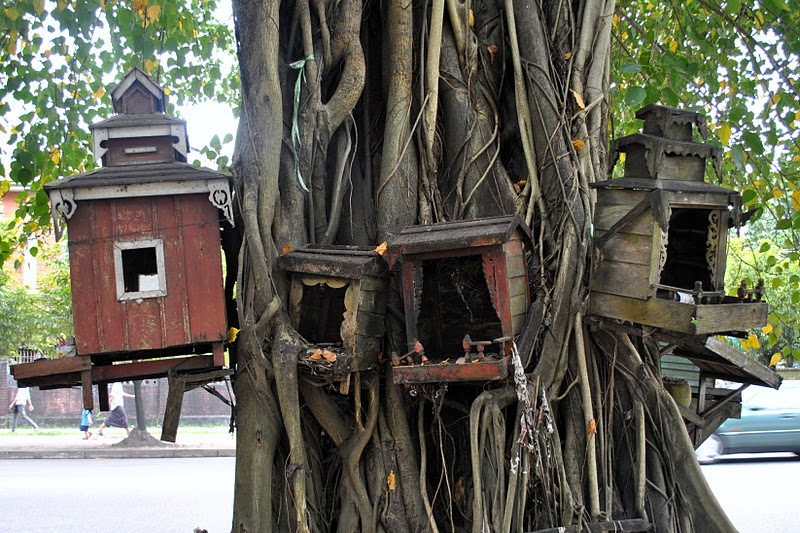
Nat (spirits worshipped in Myanmar in conjunction with Buddhism) houses built into trees along the side of the streets. There are 37 nat spirits.

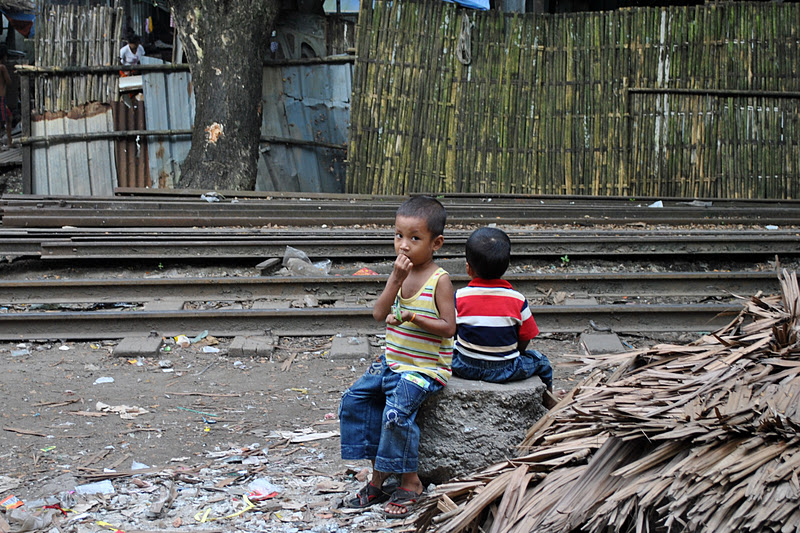
Two boys sit outside of their hut. A small hut colony (slum) lined the railroad tracks just behind our guesthouse.

Most of the housing in downtown Yangon was of this drab "soviet block" style

That night we took a night bus to Mandalay. We learned that the always “reserve” the back of the bus (the worst seats... the ones that don’t recline) for tourists. From this point onwards we made a point of asking for any seats other than the back rows. Needless to say, not the best sleep.

Wednesday, November 2, 2011

Malaysia: Penang & the Cameron Highlands

We flew from Lombok to Jakarta, then onwards to Kuala Lumpur. When we arrived we asked the advice of the customs official on how to get to Penang. He insisted the train was best (cheaper, shorter, more comfortable), so we took his advice. It was not cheaper or shorter, and the train tracks were very rough, but we arrived only a couple hours later than planned to Butterworth (on the northwest coast of peninsular Malaysia). From there it was just a quick walk across the highway to the ferry terminal, followed by a 20-minute ferry across to Georgetown, the major city on the east coast of Penang Island. It was already nearly midnight so we took a cab into town rather than walking and discovered first that the hostel we had in mind didn’t exist, and our second choice was full. We followed the advice of Jim (an interesting Rastafarian character at one guesthouse) and went to Pin Seng Hotel on Love Lane nearby. The room was rock-bottom in terms of comfort (Dewey figured that a cat could probably crawl in through the gap between our bedroom wall and the hallway) but the price was right (about $4 a person) and an eager, shirtless Chinese fellow convinced us to stay. We figured we’d stay the night then switch to a better hostel, but we actually grew fond of Pin Seng and its character and ended up staying 3 nights.

After checking into our room we headed out for a late-night bite to eat. After realizing that if you stand by a hawker stall for very long they just start serving you we had Koay Teow soup at a Chinese hawker stall on the main drag for a little over $1, where we shared a tiny little table and it's 3 stools with another Chinese fellow. 
The next morning we discovered the simple joy of Indian style breakfast.
At “Jaya”, for about $1 or $2 you could enjoy fresh roti canai, chapati or thosai (dosa) (fresh Indian flatbreads) with dal, or it’s many variations (stuffed with cheese, egg, spinach & chicken) or accompanied by other curry side dishes. Fresh Masala tea ("chai" tea made with fresh spices and served with condensed milk) and “White Coffee” (the coffee beans are roasted with palm-oil margarine, and the resulting coffee is served with condensed milk) were our beverages of choice.

Men playing boardgames on the street across from Jaya


After breakfast we set off to explore Georgetown, with the ultimate goal of finding a famous “duck rice” hawker stall in time for lunch. We strolled though the market where we saw lots of interesting things, including these unidentifyable creatures hanging at stall in the meat section. Are they rats?

A man selling freshly roasted chestnuts at a street stall

We also visited a chinese temple where a friendly Chinese tourist explained the intricate carvings on the roof to us.
After a long time walking around we ended up back at the mosque where we started (somehow we had walked in a giant circle), so gave up and went “Kapitan” (highly recommended Indian restaurant) where Dewey had Tandoori chicken and I had a lentil & spinach curry with Naan. We wandered around the city and picked up a copy of the fantastic "Penang Food Trail" map (a folding map describing many of the foods that Penang is famous for, and where to find them) from the Penang Heritage Trust.
That night we went to Red Dragon food court market for dinner. Dozens of stalls advertizing various types of “Penang Famous” foods surrounded a central area with many tables and a stage. You would go up to a stall, order a dish and indicate the area where you were going to sit. Someone would bring the dish out to you when you were ready. You could order dishes from a variety of places and there were boys running around from table to table offering to fetch you drinks. We tried fried Char Koay Teow (fat rice noodles with garlic, prawns, soy, bean sprouts, egg, chives and cockles), duck rice, fried spicy clams, and Assam Laksa soup. We made friends with a fun Swedish/English couple and enjoyed a few beers. At the stage in the center of the food court there was an entertaining scantily-clad pop music group who were preforming in celebration of the start of Oktoberfest (which has little, if anything, to do with the Bavarian counterpart).

The next day we walked around fort Cornwallis. The self-guided walking tour involved a lot of reading, and not much else. Maybe not the most riveting thing we’ve done but it was interesting from a historical perspective. We searched through Little India for lunch but realized the inner parts of Little India didn’t have any restaurants for some strange reason. We sat down for a cold drink at Jim’s guesthouse while we tried to come up with a plan for the next few days. We decided to stay one more day in Penang rather than cram everything we wanted to do into that evening. We spent a lazy evening wandering around the city, finding many interesting things.


Making rice noodles at a street stand
On our third and final day on Penang we set off on a mission to see the Tropical Fruit Farm (on the other side of Penang Island, claiming to have over 200 varieties of tropical fruit!), the Tropical Spice Garden (on the north part of the island) and the Botanical gardens (near the city). We tried to get a map at a very terrible tourist information center, but ended up taking a picture of the one they had on the counter because he claimed he didn’t have maps and didn’t know where we could get any. From this map it seemed obvious that we’d take one bus to the north part of the island then switch to a second bus that would take us right to the tropical fruit farm. We took the first bus to where its route finished but then discovered that the next bus only ran every two hours and that a cab to the tropical fruit farm would cost about $20. We tried to find something to do to kill the time but we were in the middle of nowhere so we gave up on the Tropical Fruit Farm and backtracked a bit to the Tropical Spice Garden instead. The Tropical Spice Garden ended up being very interesting and we spent quite a lot of time there wandering through the gardens. All the plants were labelled with informative placards about each plant.

There was also a bamboo garden, a cooking school and a cafe on site. We decided to have lunch at the cafe (not our cheapest lunch, but it was in a beautiful setting, and after all today was the 1-year mark for when we met in Bolivia so why not!). We ordered spiced tea & coffee and Malaysian Tapas (stuffed crab shells, “Money bags” (chicken in a wonton wrapper), curried chicken in banana leaf parcels, and shrimp wrapped with fried noodles). It was quite delicious and good value for what we got.


We headed back to Georgetown, where we wandered around some more. We checked out the mall for some great people watching and even tried some sushi (not the greatest).
We wandered around some more and came across a giant modern pet store which turned out to be a lot of fun. It was massive and had all sorts of strange animals (including sharks and gophers). There was even a fish spa! We bought some steamed peanuts from a street stand (peanuts steamed in their shells, which taste quite like creamy peanut butter) and ran into our Swedish/English friends from the night before. We headed back to Kapitan for dinner where Dewey tried the Vindaloo (not as spicy as anticipated) and I had a mutton curry with chapatti. Penang is all about the food!

We tried to arrange for a bus the next morning to the Cameron Highlands but a couple different booking offices in town told us all the buses were full. We didn’t quite believe this, so we went to talk to the ever-useful Jim at Jim’s Guesthouse and he told us to go back to the mainland and catch a bus from the main terminal. So the next morning (after our regular Indian breakfast, of course) we walked down to the pier, took the ferry (free on the return trip!) back to Butterworth, and walked to the terminal. Like most bus terminals here this one consisted of about 30 different agencies all trying to sell you tickets for the same 10 destinations. The first few people we asked said the next bus to Tanah Rata (the main town in the Cameron Highlands) was at 2:00pm. They insisted there was no bus earlier and that we should book their bus that afternoon. Well, there was actually a direct bus at 8:30am, which we found after coming across the right person, so we booked that.
Along the windy road up into the highlands the scenery began to look more and more agricultural, with hundreds and hundreds of greenhouses terraced across the hillsides and fields of vegetables too. We saw all we needed to see of some of the more touristy attractions, like the ever-popular “Strawberry Farm” where the main focus is on the collection of strawberry souvenirs (pillows, stuffed animals, magnets and literally everything else strawberry-related). Interestingly though, from what we could see from the bus it looked like entirely local tourists (or at least, Asian tourists).
We found a hostel (Kang’s Lodge) and quickly tracked down adventurous another couple (from Tennessee and Alaska) who were interested in splitting the cab ride to BOH tea plantation. We were cutting in close for time so we had a quick bite to eat (strangely enough Venison Kway Teow and Duck Vermicelli) at the popular and cheap Rosedale Bistro then hailed a taxi and split the fare four ways. The road into the plantation was definitely only wide enough for one vehicle which made the trip interesting as BOH tea plantation is very popular. We arrived too late to catch a real free tour, so we did a self-guided version. It was interesting, but more commercialized that we had hoped for. The cafe mass produced tea-bag tea. We had a cup anyways, then headed back into town. 


We checked out the local produce market (Multicrops Central Market), and enjoyed sampling various fried snacks at one stand (the experimentation was great fun until we came across a gag-worthy sardine flavoured pastry).


By popular recommendation we went for dinner at an Indian place where I was introduced to the banana leaf thali set meals. They lay a banana leaf in front of you, then pile various condiments, salads, pickles, and rice on top and finish it off with a dish of curry of your choice (mine was mutton/lamb) and a bowl of dal. If you finish something off they will quickly replenish the pile. The whole affair costs less than $3. That evening we enjoyed the relaxing and social atmosphere at the hostel.

The next morning we booked a bus ticket to Kuala Lumpur then checked out the Lonely Planet “Our Pick” recommendation for lunch (restaurant Bunga Suria). It was alright, but they didn’t have at least half of what was on the menu... and not just seasonal things, but non-perishable staples too. We caught the bus the Kuala Lumpur and arrived in the early evening. We weren’t too picky about where we stayed since we’d be here only about 18 hours, so we picked a cheap hippy type guesthouse that had seen better days in the 80’s. We were housed in a windowless closet sized room up four steep flights of stairs, with a mattress on the floor and absolutely nothing else. The toilets didn’t flush either, but I guess it did the trick. This happened to be Canadian Thanksgiving. There is no such thing as hostels with a kitchen here so making Thanksgiving dinner was out of the question. We set out to find something but were unfamiliar with the big city and ended up settling for a street-side cafe where you pick skewers of meat and then they grill them for you. It was pretty good but was going to get expensive quickly, so we stopped after a few skewers and went in search of dessert. We found a coffee house and had high hopes, but it was so-so.

A popular windshield sticker in Malaysia

The next morning we had a few chores to do, including exchanging all of our accumulated Malaysian Ringet for US dollars in preparation for our trip to Myanmar. We shopped around for the best rate, and picked a trustworthy looking place on the main drag. Because there are no ATM’s in Myanmar, and you can’t use credit or debit cards, you have to bring in all the money you will need (and extra in case of emergency), in the form of pristine, new US dollar bills, preferably $100 notes. We then finished our last blog post and took the express train to the Kuala Lumpur low-cost carrier terminal (Air Asia’s headquarters) and set off to Yangon.