Monday, November 14, 2011

Inle Lake, Myanmar

By the time we reached Nyaungshwe our immediate posse of fellow travelers had grown to about 7, the extended posse to about a dozen. These included our trekking mates David & Valeria from Chile, Aston (USA), Megsi (Australia) and Alfonso (Spain).  We all decided to stay at the same hotel (Nanda Wunn) and spent a couple days enjoying the lazy atmosphere of Nyaugshwe. There isn't an overwhelming number of things to do in Nyaungshwe but we were happy to have some time to do our laundry (hand wash it in the tub and set it to dry on the balcony). 

A pagoda near the edge of the river in downtown Naungshwe
Nyaungshwe is a neat little grid down on the edge of Inle Lake with a well established tourism scene. As a result prices are significantly higher ($3-$6 for dinner!) but there are more options as well. We enjoyed our first pizza since leaving home, and we were impressed. They actually had a wood-fired stone oven and the pizza was good! It was $6/pizza though, so we only went once. There was a Buddha museum in town that we opted not to see; it was formerly the museum of Shan Chiefs but the government took it over (in a crackdown against Shan culture and identity), removed any objects that represent Shan culture and replaced them with antique buddha images. 

Roses for sale at a stand in the Mingala Market. I absolutely adore how they are wrapped up in a damp cabbage leaf to keep them fresh; the whole situation is effortlessly (and unintentionally) stylish.
The local Mingala market was large and bustling and many street food vendors lined up outside. Here you could get curry/rice/soup/salad for about $2 or vegetable-stuffed chapati for a little over $1 (meat would cost you an additional 25 cents). 

Intha fishermen scaring fish into their nets by beating long wooden sticks on the surface of the water
On our third day in Nyaungshwe our group arranged for a full-day boat trip out onto the lake. We hired a boat and driver for 12,000 Kyat (about $15) and set off  at 8:00am ...while the daytime heat was still reasonable. On our way out into the middle of the lake we stopped to observe traditional Intha fishermen.


Dewey captured some spectacular shots of the Intha fishermen with the telephoto lens. 


First we visited a busy market and were given an hour to wander around. Our first impression was that the market was mainly aimed at tourists (not what we had in mind) as they were selling all sorts of cheap tourist knick-knacks. Fortunately, exploration a little further into the depths of the market revealed the local side.


A muddy pig makes it's way through the aisles of the market, cleaning up the vegetable debris
Women selling fresh (still flopping) fish on the side of the road by the market
Women selling freshly cooked flat-breads and fried quails eggs
Tomatoes are grown on the floating gardens in the middle of the lake. I think the color of the tomatoes shows how much they like growing in a swamp. In fact, they tomatoes look pretty red compared to others.
A pharmaceutical stand at the market. You could buy pretty much any drug you wanted here (birth control pills included), but some of the packages looked a little dated.
After the market we continued onto a floating silk workshop.You could watch the fibers being spun and then being woven into textiles. If you wanted you could purchase silk items in the floating building next door. They were beautiful, but not inexpensive, and after watching the effort that goes into weaving a single scarf you really don't feel right bartering the price down!

A women making thread from lotus root fibers. We were told that lotus thread is 8 times more expensive than silk because it is more time consuming to make.

A woman carefully re-threads her silk-weaving loom
Men play a traditional Burmese game (I wish I knew the name)
Next we visited a floating cigar factory. The front of the building was a demonstration and tasting room. They demonstrated how the cigars were made and then passed around cigars for us to try; anise-flavored cigars, and sweet tamarind-flavored cigars. I'm not generally a fan of cigars but I loved the anise cigars. They were slightly sweet and spicy and fresh. As a group we bought 50 cigars for 2000 Kyat ($2.50) and split them up between us.

A demonstration of the cigar making process


After, we visited a blacksmith where we watched a demonstration. Aside from watching the free demonstration you could choose to purchase a variety of things; scissors, bells, knives, swords, opium weights, and plenty more. Aston bought a hand-forged knife for his dad. 

 
After the blacksmith we were hungry so our boat-driver dropped us off at a restaurant. We asked him to take us to a cheap one, but I'm pretty sure he would have taken us to the same one regardless; he seemed to be quite close friends with the staff there. We had our noodle soup then walked across the bridge to the local pagoda. We were pretty tired of pagodas by this point in our trip, and I didn't even go in (I wasn't properly dressed and the we needed someone to hold all the shoes anyways). Sadly, there was a large group of children begging for money (and candy) outside the pagoda and for good reason; ignorant tourists would throw handfuls of candy at them (like they were feeding fish). I disagree with this practice as it teaches children to beg. There are so many better ways to help! I read a quote somewhere that I felt was extremely accurate: "don't give candy to the kids unless you can also give them modern dentistry". True. 

After the pagoda we stopped by a floating monstery where the monks had taught their cats to jump through hoops. It was interesting to see, but for some reason we couldn't get the camera to co-operate and so we have no pictures. But the cats jumped through hoops, I swear. It was a bit touristy, but it was free, and unusual. Our last stop on the lake was a craft shop where  a group of Paduang women lived. 


This bothered me because while it used to be a strong part of their culture now it is mostly used to impress tourists and it looks so cruel. We took one picture to make our point on this blog, but didn't dwell on it so as to not buy into the tourist exploitation.

A quote from our guidebook about the Paduang women:
 
"Originally from the Kayah state on the Thai border south of Inle Lake, the Paduang tribe - Myanmar's famous 'giraffe women' - have become a victim of their own traditions. The ancient custom of fitting young girls with brass neck-rings has made the Paduang a major tourist attraction - and a major target for exploitation on both sides of the border. Originally intended to make Paduang women less attractive to raiding parties from neighboring tribes, the application of heavy brass neck-rings causes deformation of the collar bone and upper ribs, pushing the shoulders away from the head. Many Paduang women reach a stage where they are unable to carry the weight of their own heads without the rings as additional support."

On  our way back to Nuangshwe we passed by the floating gardens where much of the produce for the local villages in grown.


Tomatoes grow on floating rows
A man harvesting goop from the bottom of the lake to be used as natural fertilizer for the floating gardens.
We also passed through some floating villages. We were amused by the fact that each floating house had a resident cat who could usually be seen climbing about around the frame of the house and on the front step. There can't be many mice in a floating house! Quite frequently there was also a big in a small stilted cage beside the house. 

Flooded pagodas
A young boy getting the hang of the one-legged rowing technique at an early age
Entire villages were built on stilts, like this
Traditional long boat canoes
A man with a mouthful of betel-nut
We stayed one more day in Naungshwe before heading back to Yangon. You could tell that it had been a heavy monsoon season; there was definitely more standing water in town than should be normal. We even tried to find one restaurant listed in our guidebook but it was physically impossible to get there unless you planned on swimming... we tried accessing it from all four possible directions.

Standing water in downtown Naungshwe.
View of the rice paddies from Viewpoint restaurant, where we waited out the rain and enjoyed some delicious appetizers
One of our favorite little things about Myanmar was the money. You had to have perfectly crisp US bills if you wanted to use them, but evidently anything goes with the local currency. We actually received the following bills in change (and managed to spend them again as well). They are completely taped up and wrapped in plastic to prevent them from deteriorating further. 


Another fun thing to find is out of print currency. This bill has an interesting story. Megsi bought it in the market for a couple dollars.


A brief history of the messed-up money situation in Myanmar (an excerpt from Wikipedia):  

"In 1972, the Union of Burma Bank issued notes for 1, 5, 10, 25, 50 and 100 kyats. In 1985, 75-kyat notes were introduced, the odd denomination possibly chosen because of dictator Ne Win's predilection for numerology; the 75-kyat note was supposedly introduced to commemorate his 75th birthday. It was followed by the introduction of 15- and 35-kyat notes on August 1, 1986.Only two years later, the government demonetized the 25-, 35-, and 75-kyat notes without warning or compensation, rendering some 75% of the country's currency worthless. The resulting economic disturbances led to serious riots (see 8888 Uprising) and eventually a coup d'état in 1988 by General Saw Maung. On September 22, 1987, banknotes for 45 and 90 kyat were introduced, both of which incorporated Ne Win's favorite number, nine. These were later also demonetized."

  
For a highly interesting Wikipedia article on the money situation in Myanmar click HERE

Saturday, November 12, 2011

Kalaw, Myanmar

After the slow start to the bus ride from Bagan to Inle we actually made pretty good time. I think the bus driver went extra fast to compensate. To be honest, a large part of me was hoping the bus was permanently broken and that we’d get a different one because it was immediately obvious that I didn’t fit in the seats. My hip to knee dimension is just too long. It is painful to sit straight and impossible to slouch. Dewey and I took turns alternating aisle-seat/window-seat since the aisle you could usually put one knee out, unless someone was sitting there. The last two hours were up steep switchbacks into the highlands, and again, this road was under manual construction, so it was slow at times.
We decided while we were on the bus that we were going to get off the bus early, in a small mountain town named Kalaw (elevation 4356ft), and hike the rest of the way to Inle lake. The bus happened to drop us off right in front of the Golden Lily guesthouse, where we were mobbed by various trekking guides and guesthouses eager to have our business. Trekking is the main (only?) tourist attraction in the town so they all depend on it to some degree.  It was overwhelming and for lack of a better way to decide we just went with the guesthouse right by the bus stop. It happened to be the guesthouse recommended by Lonely Planet and the owners were also tour guides. After settling in we went to chat to one of the guides about trekking options. Because the trails are not well marked, and there are surrounding areas where foreigners are not allowed, it is not recommended to trek without a guide.We were planning on hanging out in Kalaw for a day but were forced to make a pretty quick decision since it is cheaper to trek in larger groups (rather than just the two of us) and there was a group leaving the next morning, but no other groups planned for the next couple days.
We went to have a late lunch at the “Seven Sisters” café nearby, while we made our decision. We had a couple lovely soups (I had Shan “pumpkin” soup, and Dewey had Mulligatawny) with a side of rice and beans. The pumpkin here isn’t like the pumpkin at home. It’s a firm green-coloured vegetable with not much in common with pumpkin as far as I can tell… but it was tasty. The architecture (and climate) in Kalaw was strikingly more European than elsewhere in Myanmar. It looked almost Swiss Alps in way. We found it interesting that there were pine trees and rice patties growing side by side. The air was cleaner and cooler, and things were a little bit cleaner and less chaotic. Kalaw also used to be a British Hill station, and now is an army base for the Myanmar military.
The town has a significant population of Nepali and Indians (Hindus, Sikhs & Muslims) who came here to building the roads  railways during the British period. That evening we went for dinner at the small Everest Nepali Food Center where you could get dhal baht (set menu of dal, chapatti, soup, simple curry & condiments) for about $2. There was some sort of fundraiser/celebration happening on the main street in town and people were making music, dancing, and asking for money. OH and setting off fireworks, of course!
After dinner we went on a hunt for lens solution. At some point mine must have leaked because I started with enough to get me through the time in Myanmar and then all of a sudden it ran out. Funny thing is, you can’t really find lens solution in Myanmar. I had a hard time trying to explain to the pharmacist what I was looking for, so I eventually took out my contact lens to show her. She said I’d have to go to a bigger city to find some.

The next morning we set off on our trek. Harri Singh, a local of Indian ancestry, was our guide. We went by car for a little while until we reached a farmhouse where we stopped to meet up with the group. It turns out that the rest of our group was doing the 3-day trek (we were doing the 2-day trek) so that just meant that we met them on the morning of day 2. The downside to that was that we really just missed day 1. It wasn't just a more condensed version of the same trek.  While we waited for the group a friendly grandfather-type invited us into his kitchen and gave us Chinese tea and bean fry (beans, peanuts, sesame seeds and chickpeas dry-roasted and tossed with lots of oil and salt). In return he asked me to read him some passages from an English book of Buddhist verses so that he could practice his English pronunciation. 

Bean Fry
A kitchen hut
The trek took us through many very small villages; some of which were accessible by road, others not.

Chili peppers drying at the house where we stop for lunch on the first day.
We hike through fields and rice paddies along the way. You can walk along the little ridges of hardened mud which divide the rice paddies.
Boys in the first village eagerly gather around to view the pictures I have taken
The first village we hiked through
A grandmother and her swaddled grandson

An elderly woman sits by the edge of the creek and prepares betel-nut to chew. A betel nut leaf is smeared with lime, then sprinkled with betel nut shavings and wrapped up into a neat little package about the size of your thumb. The whole thing it sucked/chewed on and acts as a stimulant/appetite suppressant. It also turns your teeth, gums, and saliva red.
At one village we were lucky to come across a group of women making glutinous rice. They pound hot rice for about 15 minutes until it forms a sticky mass (seen above).
The scenery looks more familiar here; it could easily be California, or even Europe
The yellow fields are sesame seed crops. I believe the cow in the front is a Brahma (the most common kind of cow around Myanmar).


At one point during the trek our guide turned quickly around to face us and told us to stomp our feet on the path. Confused, we asked why. He said there was a big black cobra beside the path and we needed to scare it away. I was kindof dissapointed we didn't get to see it, but our guide assured us this was best. Myanmar is home to no fewer than 39 species of venemous snakes, including vipers and cobras. They reportedly like to hang out in the watery environment of rice paddies. Our guide told us there was no antivenom available in Myanmar, but I later read otherwise. In all likelyhood, there is anti-venom but no accesibility to anti-venom (after all, the WHO ranks Myanmar's health care system as the worst in the world). So stay away from snakes! We never saw any snakes in Myanmar, but we saw snake-skin.


Pink pepper (also called citrus pepper) grows wild here. We picked a few berries to chew on our hike. They are spicy and have hints of citrus. You pierce the berry once with your teeth and the slightly numbing spicy taste will linger for about 10 minutes. It's quite delicious.
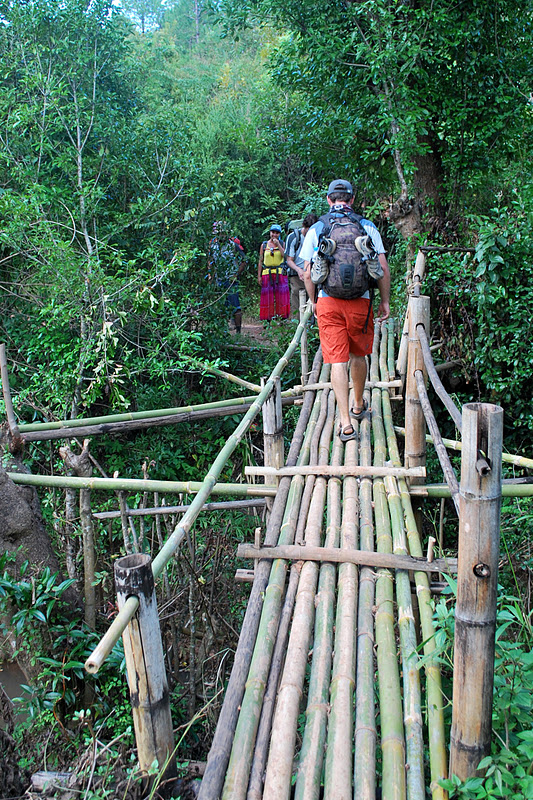
Bamboo bridges to cross creeks and ravines
Because of ongoing violence between the government forces and 'rebel groups' (usually indigenous minority groups), there are many areas in Myanmar where foreigners are forbidden from visiting. The entire Kayah state (home to Padaung and Kayin/Karen tribes, amongst others) is off limits to foreigners and is in a constant state of violence. At one point out guide pointed out some trails, and said that they were good cycling trails but that foreigners weren't permitted because of the above reasons, and the fact that there were opium fields growing there. Harri said "if you see poppies, you are already being watched, and you are in trouble". Myanmar is the world's second largest producer of illicit opium (and hence, heroin), and like most things in Myanmar, it is entirely under military government control. Most of the people growing opium are tribes-people living below the poverty line.

You can read a very interesting Wikipedia article on the subject HERE. 

Shortly before sunset we arrived to the small village where we would be spending the night. We were shown to the village monastery/orphanage where we would sleeping. The monastery was a large, rectangular, two-story building, with the top floor being one big room with short bamboo "walls" to divide off the sleeping quarters. Our group of 5 slept on thin mattresses in one divided quarter, and the monks of the orphanage slept in the division next to us.

A woman in traditional dress returning from the fields after the day's work

A young boy cooks dinner by flashlight (and firelight) in a hut
Our feast at the end of day 1: curried chicken, cucumber salad, steamed vegetables, spiced stir-fried okra, rice, pumpkin soup, and papadams
Young girls near the monastery watch us with interest as we get ready to continue hiking on Day 2
There was road work being done nearby and one of the machines had broken down so they spent the night trying to fix it, and it created quite a raucous. Most of our group has a pretty restless night, but luckily Dewey and I had our earplugs in, and therefore slept pretty well considering. In the morning we are woken up by the sound of the young monks chanting their morning prayers - at 5:00am, right next to where we were sleeping.

A group of boys from the village beg me to take their picture, then crowd around eagerly to see the result
The flower of an okra plant
Rice paddies & hills lined with pine trees

A young girl wearing traditional headscarves
Grade two students grouped together at one end of a 3-grade schoolhouse. They all stand up to sing the verses they are memorizing when prompted by their young teacher. Notice that most of them are wearing the traditional white Myanmar make-up, which also helps to protect their faces from the sun.
On the road down towards the lake we pass a number of girls in traditional dress (and make-up) riding water-buffalo. This looks like a scene that has been staged to demonstrate culture, except that it wasn't (this is still everyday life here).
At mid-day on the second day we arrived to a small town at the south end of the lake. It is difficult to tell where the lake begins, and where the swamps that surround it end. There is no defined "shore" anywhere around the lake. In fact, houses on stilts and agricultural plots extend for a long ways into the middle of the lake, "floating" on reed islands. Our guide book put it well :"Inle sits like a puddle on an enormous carpet of greenery".
 
There we had spicy noodle soup with egg (a classic dish) for lunch before catching a longboat to the other end of the lake where most of the budget accommodation is. Before getting into the boat we had to pay a $5 (per person) government fee/permit. We try as much as possible to avoid paying anything to the government, but aside from cutting out a visit to Inle Lake from your trip, this one was hard to avoid. We did however, get some enjoyment out of using our worst US bills to pay the government fees (we did this once before at Bagan). It is next to impossible to use anything other than pristine, new US bills in Myanmar, but for some reason you can often get rid of your otherwise unusable ones at the government fee booths. 
The following is an excerpt from our guide book and helps to explain the following photos.
"Most Intha people get around using traditional flat-bottomed skiffs propelled by a single wooden paddle. The Intha technique of leg-rowing - where one leg is wrapped around the paddle to drive the blade through the water in a snake-like motion - is unique. " (Lonely Planet - Myanmar)
While there were certainly many Intha fisherman on the lake, the predominant type of boat was the narrow long-boats.

The boat ride from one end of the lake to the other takes around an hour and a half. As we neared Nyaungshwe, the town  at the other end of the lake where we were going to stay, we saw many women along the side of the river washing their clothes. 
 
We  arrived in Nyaungshew mid-afternoon and walked to Nanda Wunn Hotel, where our bags had been brought. We were happy to get our packs off our backs and our shoes off our feet!

As an aside, here are some interesting facts about Myanmar:

- Population: 60 million (vs. 33 million in Canada)
- Gross national income per capita (in international $): 1,020 (vs. $38,710 in Canada)
- Probability of dying under 5 years of age: 71 (per 1000 live births) (vs. 6 in Canada)

- Expenditure on health per capita: $23 (vs. $4,196 in Canada)
- The World Health Organization ranked Burma's health care system as 190th in the world (the worst performing of all countries (Canada is 30ths, Haiti is 138th)